Jumat, 19 Oktober 2012

[Z448.Ebook] Free Ebook What Do You Do With an Idea?, by Kobi Yamada

Free Ebook What Do You Do With an Idea?, by Kobi Yamada

After downloading the soft file of this What Do You Do With An Idea?, By Kobi Yamada, you could start to review it. Yeah, this is so pleasurable while someone needs to review by taking their large books; you remain in your brand-new method by only manage your device. And even you are operating in the office; you could still make use of the computer system to review What Do You Do With An Idea?, By Kobi Yamada totally. Naturally, it will not obligate you to take many web pages. Simply web page by page depending on the time that you need to review What Do You Do With An Idea?, By Kobi Yamada

What Do You Do With an Idea?, by Kobi Yamada

What Do You Do With an Idea?, by Kobi Yamada


What Do You Do With an Idea?, by Kobi Yamada

Free Ebook What Do You Do With an Idea?, by Kobi Yamada

Make use of the sophisticated technology that human establishes today to locate guide What Do You Do With An Idea?, By Kobi Yamada effortlessly. However initially, we will certainly ask you, how much do you like to review a book What Do You Do With An Idea?, By Kobi Yamada Does it consistently until coating? For what does that book check out? Well, if you really enjoy reading, try to review the What Do You Do With An Idea?, By Kobi Yamada as one of your reading collection. If you just checked out guide based upon requirement at the time and also unfinished, you have to try to like reading What Do You Do With An Idea?, By Kobi Yamada initially.

There is no question that publication What Do You Do With An Idea?, By Kobi Yamada will certainly still make you motivations. Even this is just a book What Do You Do With An Idea?, By Kobi Yamada; you could find lots of categories as well as sorts of books. From entertaining to adventure to politic, and sciences are all provided. As what we mention, below our company offer those all, from popular authors as well as author worldwide. This What Do You Do With An Idea?, By Kobi Yamada is one of the compilations. Are you interested? Take it currently. Exactly how is the means? Learn more this article!

When somebody must go to the book stores, search store by establishment, rack by rack, it is very frustrating. This is why we offer the book collections in this site. It will alleviate you to look the book What Do You Do With An Idea?, By Kobi Yamada as you like. By looking the title, publisher, or authors of the book you desire, you can find them rapidly. In your home, workplace, or perhaps in your way can be all best location within internet connections. If you intend to download the What Do You Do With An Idea?, By Kobi Yamada, it is very easy then, due to the fact that now we extend the link to acquire and make deals to download What Do You Do With An Idea?, By Kobi Yamada So simple!

Curious? Naturally, this is why, we suppose you to click the link web page to check out, then you could enjoy the book What Do You Do With An Idea?, By Kobi Yamada downloaded till finished. You can conserve the soft data of this What Do You Do With An Idea?, By Kobi Yamada in your gizmo. Certainly, you will bring the device all over, will not you? This is why, every single time you have extra time, whenever you can delight in reading by soft duplicate book What Do You Do With An Idea?, By Kobi Yamada

What Do You Do With an Idea?, by Kobi Yamada

A New York Times Best Seller and award-winning book, What Do You Do With an Idea? is for anyone who's ever had a big idea.

This is the story of one brilliant idea and the child who helps to bring it into the world. As the child's confidence grows, so does the idea itself. And then, one day, something amazing happens. This is a story for anyone, at any age, who's ever had an idea that seemed a little too big, too odd, too difficult. It's a story to inspire you to welcome that idea, to give it some space to grow, and to see what happens next. Because your idea isn't going anywhere. In fact, it's just getting started.

Praise for What Do You Do With an Idea?

National best seller, appearing in the New York Times, Wall Street Journal, USA Today, and Publishers Weekly.

Gold medal winner of the Independent Publishers Award, the Washington State Book Award, and the Moonbeam Children's Book Award.

"What makes this message so unique is the simple but beautiful way it's delivered, in narrative and illustration, through the eyes and voice of an innocent and hopeful child. What Do You Do With An Idea? is a spectacular book for all ages and is a wonderful treasure for any home or school library." —The Children's Book Review

"Despite the fact that it's Yamada's first time writing a children's book, it's had breakout success, selling over 300,000 copies since its publication date of January 2014." —Publishers Weekly

  • Sales Rank: #178 in Books
  • Brand: Compendium
  • Published on: 2014-02-01
  • Original language: English
  • Number of items: 1
  • Dimensions: 10.75" h x 9.00" w x .75" l, .0 pounds
  • Binding: Hardcover
  • 36 pages
Features
  • The story of a boy and his daring idea
  • Encourage thinking big, dreaming outside the box, exploration in life
  • Written by Kobi Yamada
  • Illustrated by Mae Besom
  • Hardcover with jacket

About the Author
Kobi Yamada is the creator of many inspiring gift books and ideas as well as the president of Compendium, a company of amazing people doing amazing things. He happily lives with the love of his life and their two super fun kids in the land of flying salmon where he gets to believe in his ideas all day long. He thinks he just might be the luckiest person on the planet.

Most helpful customer reviews

78 of 79 people found the following review helpful.
A SIMPLE MASTERPIECE WHICH REMINDS US THAT ONE SMALL IDEA HAS THE POWER TO CHANGE THE WORLD!
By The Literacy Advocate
Even if this lovely picture book had not won an independent Publishers Gold Book Award, it would still deserve every bit of the attention which it has begun to receive. A young boy has something precious which he himself has created -- an idea, and despite the fact that others discourage and disregard it, he finds the inner strength to hold on to his idea, to nurture it, and to begin to keep it company. Eventually his idea goes on to do something really special...it shows the boy that it and therefore, he, has the power to change the world.

If the reader peeks carefully at the little idea, one can see it begin to grow. It begins its life looking like an egg, a perfect metaphor as we wait for the idea to hatch, or break out of its confining shell. The boy's egg is a yellow-gold color that makes one think of the sun or of light...just as light illuminates, so can a nurtured idea. The discriminating reader (often an observant child!) may notice that midway into the story, the idea egg appears to be sporting a little crack, which continues to spread. Does this suggest that his idea is cracking or breaking? Oh no, reader...this little idea is about to sprout wings, burst from its shell, and take wing to change the world!

Lovely sepia colored illustrations provide a perfect backdrop for the little golden idea as it grows. This book is gorgeous on all levels -- visually, emotionally, and creatively. A perfect gift for any child, or for any adult who enjoys a reminder once in a while (like me!) about the best aspects of our humanity.

88 of 92 people found the following review helpful.
Calling all business and community leaders!
By Jessica R Aalami
I can’t say enough about how this book delivers a pivotal work, community and life lesson: Nurture your ideas and you can change the world. The story, gorgeously illustrated, takes a complex process and distills it in such a tender way so you will no longer be afraid of your most precious, earth-changing ideas. As an innovation coach for business and community leaders, this process of exploring, growing and freeing ‘out of the box’ ideas is usually a long-term process. In just a few beautifully illustrated pages, the book accomplishes what days and weeks of workshops try to. I am thrilled to be able to use it in my own work. A real treasure.

60 of 62 people found the following review helpful.
What a great little book!
By Julie Y - Michigan
I purchased this book to read for March is Reading month for 2nd grade - We All loved it so much!!!! I gave the kids small wooden eggs with the word idea stamped on. I plan on reading this again for other grades - highly recomend!!!

See all 393 customer reviews...

What Do You Do With an Idea?, by Kobi Yamada PDF
What Do You Do With an Idea?, by Kobi Yamada EPub
What Do You Do With an Idea?, by Kobi Yamada Doc
What Do You Do With an Idea?, by Kobi Yamada iBooks
What Do You Do With an Idea?, by Kobi Yamada rtf
What Do You Do With an Idea?, by Kobi Yamada Mobipocket
What Do You Do With an Idea?, by Kobi Yamada Kindle

What Do You Do With an Idea?, by Kobi Yamada PDF

What Do You Do With an Idea?, by Kobi Yamada PDF

What Do You Do With an Idea?, by Kobi Yamada PDF

Senin, 15 Oktober 2012

[T898.Ebook] Free Ebook Probability, Random Variables and Stochastic Processes with Errata Sheet, by Athanasios Papoulis, S. Unnikrishna Pillai

Free Ebook Probability, Random Variables and Stochastic Processes with Errata Sheet, by Athanasios Papoulis, S. Unnikrishna Pillai

Just how is making sure that this Probability, Random Variables And Stochastic Processes With Errata Sheet, By Athanasios Papoulis, S. Unnikrishna Pillai will not shown in your shelfs? This is a soft data book Probability, Random Variables And Stochastic Processes With Errata Sheet, By Athanasios Papoulis, S. Unnikrishna Pillai, so you could download and install Probability, Random Variables And Stochastic Processes With Errata Sheet, By Athanasios Papoulis, S. Unnikrishna Pillai by buying to obtain the soft documents. It will certainly ease you to read it every time you require. When you really feel lazy to relocate the published publication from the home of workplace to some place, this soft documents will certainly ease you not to do that. Due to the fact that you could just save the information in your computer unit as well as gizmo. So, it enables you review it almost everywhere you have determination to read Probability, Random Variables And Stochastic Processes With Errata Sheet, By Athanasios Papoulis, S. Unnikrishna Pillai

Probability, Random Variables and Stochastic Processes with Errata Sheet, by Athanasios Papoulis, S. Unnikrishna Pillai

Probability, Random Variables and Stochastic Processes with Errata Sheet, by Athanasios Papoulis, S. Unnikrishna Pillai


Probability, Random Variables and Stochastic Processes with Errata Sheet, by Athanasios Papoulis, S. Unnikrishna Pillai

Free Ebook Probability, Random Variables and Stochastic Processes with Errata Sheet, by Athanasios Papoulis, S. Unnikrishna Pillai

Only for you today! Discover your preferred e-book right below by downloading as well as getting the soft data of guide Probability, Random Variables And Stochastic Processes With Errata Sheet, By Athanasios Papoulis, S. Unnikrishna Pillai This is not your time to commonly visit guide shops to purchase a publication. Right here, selections of e-book Probability, Random Variables And Stochastic Processes With Errata Sheet, By Athanasios Papoulis, S. Unnikrishna Pillai and also collections are offered to download and install. Among them is this Probability, Random Variables And Stochastic Processes With Errata Sheet, By Athanasios Papoulis, S. Unnikrishna Pillai as your preferred book. Getting this publication Probability, Random Variables And Stochastic Processes With Errata Sheet, By Athanasios Papoulis, S. Unnikrishna Pillai by online in this site could be realized now by seeing the link page to download. It will be easy. Why should be right here?

When some individuals looking at you while reviewing Probability, Random Variables And Stochastic Processes With Errata Sheet, By Athanasios Papoulis, S. Unnikrishna Pillai, you could really feel so pleased. But, rather than other individuals feels you need to instil in yourself that you are reading Probability, Random Variables And Stochastic Processes With Errata Sheet, By Athanasios Papoulis, S. Unnikrishna Pillai not because of that factors. Reading this Probability, Random Variables And Stochastic Processes With Errata Sheet, By Athanasios Papoulis, S. Unnikrishna Pillai will offer you greater than people appreciate. It will certainly guide to understand more than the people staring at you. Already, there are lots of sources to learning, reviewing a book Probability, Random Variables And Stochastic Processes With Errata Sheet, By Athanasios Papoulis, S. Unnikrishna Pillai still comes to be the first choice as a fantastic way.

Why need to be reading Probability, Random Variables And Stochastic Processes With Errata Sheet, By Athanasios Papoulis, S. Unnikrishna Pillai Once more, it will depend upon just how you feel and think about it. It is undoubtedly that people of the benefit to take when reading this Probability, Random Variables And Stochastic Processes With Errata Sheet, By Athanasios Papoulis, S. Unnikrishna Pillai; you could take much more lessons straight. Even you have not undertaken it in your life; you could gain the experience by checking out Probability, Random Variables And Stochastic Processes With Errata Sheet, By Athanasios Papoulis, S. Unnikrishna Pillai And also currently, we will certainly introduce you with the online book Probability, Random Variables And Stochastic Processes With Errata Sheet, By Athanasios Papoulis, S. Unnikrishna Pillai in this web site.

What sort of book Probability, Random Variables And Stochastic Processes With Errata Sheet, By Athanasios Papoulis, S. Unnikrishna Pillai you will choose to? Currently, you will not take the published book. It is your time to obtain soft documents publication Probability, Random Variables And Stochastic Processes With Errata Sheet, By Athanasios Papoulis, S. Unnikrishna Pillai instead the published documents. You can appreciate this soft data Probability, Random Variables And Stochastic Processes With Errata Sheet, By Athanasios Papoulis, S. Unnikrishna Pillai in any time you anticipate. Also it is in expected place as the other do, you can read guide Probability, Random Variables And Stochastic Processes With Errata Sheet, By Athanasios Papoulis, S. Unnikrishna Pillai in your gizmo. Or if you desire more, you can read on your computer or laptop computer to get full screen leading. Juts find it here by downloading and install the soft documents Probability, Random Variables And Stochastic Processes With Errata Sheet, By Athanasios Papoulis, S. Unnikrishna Pillai in web link web page.

Probability, Random Variables and Stochastic Processes with Errata Sheet, by Athanasios Papoulis, S. Unnikrishna Pillai

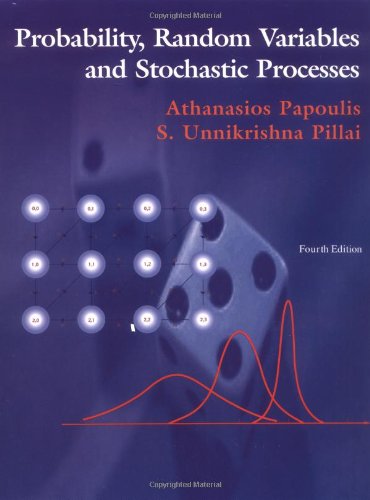
The fourth edition of Probability, Random Variables and Stochastic Processes has been updated significantly from the previous edition, and it now includes co-author S. Unnikrishna Pillai of Polytechnic University. The book is intended for a senior/graduate level course in probability and is aimed at students in electrical engineering, math, and physics departments. The authors' approach is to develop the subject of probability theory and stochastic processes as a deductive discipline and to illustrate the theory with basic applications of engineering interest. Approximately 1/3 of the text is new material--this material maintains the style and spirit of previous editions. In order to bridge the gap between concepts and applications, a number of additional examples have been added for further clarity, as well as several new topics.

  • Sales Rank: #1370967 in Books
  • Brand: Brand: McGraw-Hill Science/Engineering/Math
  • Published on: 2001-12-14
  • Original language: English
  • Number of items: 1
  • Dimensions: 9.50" h x 1.40" w x 7.50" l,
  • Binding: Hardcover
  • 304 pages
Features
  • Used Book in Good Condition

Amazon.com Review
This text is a classic in probability, statistics, and estimation and in the application of these fields to modern engineering problems. Probability, Random Variables, and Stochastic Processes assumes a strong college mathematics background. The first half of the text develops the basic machinery of probability and statistics from first principles while the second half develops applications of the basic theory. Topics in the first section include probability distributions and densities, random variables and vectors, expectations, covariance, correlations, functions of random variables and vectors, and conditional distributions and densities. In this third edition of the text, the second half of the book has been substantially updated and expanded to include new or revised discussions of the following topics: mean square estimation, likelihood tests, maximum entropy methods, Monte Carlo techniques, spectral representations and estimation, sampling theory, bispectra and system identification, cyclostationary processes, deterministic signals in noise, and the Wiener and Kalman filters. Probability, Random Variables, and Stochastic Processes covers a remarkable density of material and the clarity of both presentation and notation make this book invaluable as a text and a reference.

About the Author
S. Unnikrishna Pillai is a Professor of Electrical and Computer Engineering at Polytechnic Institute of NYU in Brooklyn, New York. His research interests include radar signal processing, blind identification, spectrum estimation, data recovery and wavform diversity. Dr. Pillai is the author of Array Signal Processign and co-author of Spectrum Estimation and system Identification, Prof. Papoulis' Probability, Random Variables and Stochastic processes (Fourth edition), and Space Based Radar - Theory & Applications.

Most helpful customer reviews

61 of 62 people found the following review helpful.
Found no substitute for a difficult subject
By N N Taleb
When readers and students ask to me for a useable book for nonmathematicians to get into probability (or a probabilistic approach to statistics), before embarking into deeper problems, I suggest this book by the Late A. Papoulis. I even recommend it to mathematicians as their training often tends to make them spend too much time on limit theorems and very little on the actual "plumbing".
The treatment has no measure theory, cuts to the chase, and can be used as a desk reference. If you want measure theory, go spend some time reading Billingsley. A deep understanding of measure theory is not necessary for scientific and engineering applications; it is not necessary for those who do not want to work on theorems and technical proofs.
I've notice a few complaints in the comments section by people who felt frustrated by the treatment: do not pay attention to them. Ignore them. It the subject itself that is difficult, not this book. The book, in fact, is admirable and comprehensive given the current state of the art.
I am using this book as a benchmark while writing my own, but more advanced, textbook (on errors in use of statistical models). Anything derived and presented in Papoulis, I can skip. And when students ask me what they need as pre-requisite to attend my class or read my book, my answer is: Papoulis if you are a scientist, Varadhan if you are more abstract.

6 of 6 people found the following review helpful.
Classic Book on a Very Difficult Topic
By sp
I cut my teeth from the 2nd edition of this classic text and later actually went out and bought the 1st edition (1965)
because multiple people that I work with mentioned that later editions were watered down compared to the original edition.
I think a more accurate statement is that more applications chapters were added in later
editions (entropy, queuing theory, etc..) and the first edition is geared more toward laying out the basic underlying theory.
In any case, any engineer or student working in Kalman filtering or communications would be well served by
having a copy of this book at his/her reach. In my opinion there is never any one best book on any topic but this
book is an element of the spanning set of books that should be consulted by engineering students/professionals on this difficult topic. Other classic books that I would
recommend along with Papoulis are

1. Probability and Stochastic Processes for Engineers by Helstrom (written by one of the fathers of modern detection theory)
2. An Introduction to Probability and Stochastic Processes by Melsa and Sage (Dover has recently reprinted this classic)

Although I am not a big fan of newer textbooks the following books are the best of the more recent texts

1. Ibe, "Fundamentals of Applied Probability and Random Processes" (this book is very straightforward and written for the average student; good place to start for the novice)
2. Kay, "Intuitive Probability and Random Processes using MATLAB" (excellent book; best of all modern texts)
3. Dolecek, Random Signals and Processes Primer with MATALB (really brings the subject to life...best used as supplementary reading)
4. Jacobs, "Stochastic Processes for Physicists" (learn the Ito calculus painlessly... Book is also a good intro for engineers despite the title)

4 of 4 people found the following review helpful.
Material Presented in Clear Albeit Unorganized Fashion
By Daniel Greenheck
I'm using this book for a a graduate level engineering course on probability theory and random stochastic processes. I took a probability theory course in undergrad and ended up getting a C, so I was very worried about approaching the subject a second time. There's no getting around the fact that the subject area is difficult. However, this book explains the concepts quite well and provides ample examples.

However, the examples also get in the way of the core material. The book is laid out very poorly and there is little organization within the chapters themselves. The delineation between the theory and the examples is not easily apparent, so it often feels like a jumbled mess. Honestly, a better layout with the examples perhaps separated from the core material and I would rate this book 5-stars.

In conclusion, I recommend this book, but the lack of organization means self-study is more of a chore than it should be.

See all 65 customer reviews...

Probability, Random Variables and Stochastic Processes with Errata Sheet, by Athanasios Papoulis, S. Unnikrishna Pillai PDF
Probability, Random Variables and Stochastic Processes with Errata Sheet, by Athanasios Papoulis, S. Unnikrishna Pillai EPub
Probability, Random Variables and Stochastic Processes with Errata Sheet, by Athanasios Papoulis, S. Unnikrishna Pillai Doc
Probability, Random Variables and Stochastic Processes with Errata Sheet, by Athanasios Papoulis, S. Unnikrishna Pillai iBooks
Probability, Random Variables and Stochastic Processes with Errata Sheet, by Athanasios Papoulis, S. Unnikrishna Pillai rtf
Probability, Random Variables and Stochastic Processes with Errata Sheet, by Athanasios Papoulis, S. Unnikrishna Pillai Mobipocket
Probability, Random Variables and Stochastic Processes with Errata Sheet, by Athanasios Papoulis, S. Unnikrishna Pillai Kindle

Probability, Random Variables and Stochastic Processes with Errata Sheet, by Athanasios Papoulis, S. Unnikrishna Pillai PDF

Probability, Random Variables and Stochastic Processes with Errata Sheet, by Athanasios Papoulis, S. Unnikrishna Pillai PDF

Probability, Random Variables and Stochastic Processes with Errata Sheet, by Athanasios Papoulis, S. Unnikrishna Pillai PDF

Minggu, 07 Oktober 2012

[K347.Ebook] Free PDF The Way the World Works: Essays, by Nicholson Baker

Free PDF The Way the World Works: Essays, by Nicholson Baker

Now, exactly how do you understand where to buy this publication The Way The World Works: Essays, By Nicholson Baker Never ever mind, now you could not visit the publication establishment under the intense sunlight or evening to browse guide The Way The World Works: Essays, By Nicholson Baker We right here consistently assist you to find hundreds kinds of e-book. One of them is this publication entitled The Way The World Works: Essays, By Nicholson Baker You could go to the web link page provided in this set as well as then go with downloading. It will not take even more times. Merely connect to your net gain access to as well as you could access the publication The Way The World Works: Essays, By Nicholson Baker on-line. Obviously, after downloading and install The Way The World Works: Essays, By Nicholson Baker, you might not print it.

The Way the World Works: Essays, by Nicholson Baker

The Way the World Works: Essays, by Nicholson Baker


The Way the World Works: Essays, by Nicholson Baker

Free PDF The Way the World Works: Essays, by Nicholson Baker

Book lovers, when you require a new book to review, locate guide The Way The World Works: Essays, By Nicholson Baker right here. Never ever worry not to discover just what you require. Is the The Way The World Works: Essays, By Nicholson Baker your required book currently? That holds true; you are really an excellent reader. This is a best book The Way The World Works: Essays, By Nicholson Baker that originates from excellent author to share with you. The book The Way The World Works: Essays, By Nicholson Baker supplies the very best experience and lesson to take, not just take, but likewise discover.

Maintain your method to be right here and also read this resource finished. You can take pleasure in searching the book The Way The World Works: Essays, By Nicholson Baker that you really refer to obtain. Right here, obtaining the soft documents of the book The Way The World Works: Essays, By Nicholson Baker can be done quickly by downloading in the link resource that we give here. Of course, the The Way The World Works: Essays, By Nicholson Baker will certainly be your own quicker. It's no have to get ready for the book The Way The World Works: Essays, By Nicholson Baker to get some days later on after buying. It's no should go outside under the heats at mid day to go to guide establishment.

This is a few of the benefits to take when being the participant and also obtain guide The Way The World Works: Essays, By Nicholson Baker here. Still ask exactly what's various of the various other site? We supply the hundreds titles that are produced by advised writers and authors, worldwide. The connect to purchase and download The Way The World Works: Essays, By Nicholson Baker is additionally very simple. You may not discover the complex website that order to do even more. So, the means for you to get this The Way The World Works: Essays, By Nicholson Baker will be so very easy, won't you?

Based upon the The Way The World Works: Essays, By Nicholson Baker specifics that we offer, you might not be so baffled to be below and to be participant. Get now the soft documents of this book The Way The World Works: Essays, By Nicholson Baker and also save it to be yours. You conserving can lead you to stimulate the simplicity of you in reading this book The Way The World Works: Essays, By Nicholson Baker Even this is kinds of soft documents. You could really make better chance to get this The Way The World Works: Essays, By Nicholson Baker as the suggested book to check out.

The Way the World Works: Essays, by Nicholson Baker

New York Times bestselling author Nicholson Baker has assembled a “provocative and entertaining” (The Wall Street Journal) collection of his most original and brilliant pieces from the last fifteen years.

From political controversy to the intimacy of his own life, from forgotten heroes of pacifism to airplane wings, telephones, paper mills, David Remnick, Joseph Pulitzer, the OED, and the manufacture of the Venetian gondola, Nicholson Baker ranges over the map of life to examine what troubles us, what eases our pain, and what brings us joy. The Way the World Works is a keen-minded, generous-spirited compendium by a modern American master.

  • Sales Rank: #735795 in Books
  • Brand: Brand: Simon Schuster
  • Published on: 2013-08-20
  • Released on: 2013-08-20
  • Original language: English
  • Number of items: 1
  • Dimensions: 8.37" h x .90" w x 5.50" l, .63 pounds
  • Binding: Paperback
  • 336 pages
Features
  • Used Book in Good Condition

Review
“Baker is one of the most beautiful, original and ingenious prose stylists to have come along in decades . . . and takes a kind of mad scientist's delight in the way things work and how the world is put together.” (Charles McGrath The New York Times Magazine)

“[A] winning new book. . . . This singular writer . . . can mount an argument skillfully and deliver an efficient conclusive kick.” (The San Francisco Chronicle)

“Nicholson Baker is such a swell, smart writer that he rarely - maybe never - tips his hand.... In Baker's view the mundane, closely enough observed, may be the skate key to the sublime.” (Carolyn See The Washington Post)

“A fundamentally radical author . . . you can never be sure quite where Baker is going to take you. . . . [He] is an essayist in the tradition of GK Chesterton and Max Beerbohm, writing winning fantasies upon whatever chance thoughts may come into his head.” (Financial Times (London))

“What these works share is a sense that how we think, our idiosyncratic dance with both experience and memory, defines who we are.” (The Los Angeles Times)

“His prose is so luminescent and so precise it manually recalibrates our brains.” (Lev Grossman Time)

“Baker looks at the world around us in a way that is not only artful and entertaining but instructive.” (Charleston Post & Courier)

“Mr. Baker is a wise and amiable cultural commentator worth listening to. . . . [his] prose is polished, witty . . . his essays are always provocative and entertaining.” (Cynthis Crossen The Wall Street Journal)

“Baker's new essay collection, The Way the World Works, is always absorbing, merging his interest in solid, tangible objects with his devotion to the life of the mind. . . . simply dazzling.” (Seattle Times)

“Exhilarating . . . Eye-opening . . . Baker continues his project of bringing new dimensions and idiosyncrasies to the personal essay, which he is devoted to reviving and reinventing.” (The Boston Globe)

“If only more of the literary world worked the way Baker does. . . . You cannot deny the courage of the writer. . . . Baker is singular.” (The Buffalo News)

About the Author
Nicholson Baker is the author of nine novels and four works of nonfiction, including Double Fold, which won a National Book Critics Circle Award, and House of Holes, a New York Times Notable Book of the Year. His work has appeared in�The�New Yorker, Harper’s, and The New York Review of Books.�He lives in Maine with his family.

Excerpt. � Reprinted by permission. All rights reserved.
Way the World Works String
I was two years old when we moved to Rochester, New York. We lived in an apartment on a street that was only a block long, called Strathallan Park.

The shortness of the street was perfect, I thought: it had two ends and not much middle, like a stick that you pick up unconsciously to tap against a fence, or like one of those pieces of string that the people in the food department at Sibley’s, the downtown department store, cut from wall-mounted spools to tie up a box holding a small cake. You could run from our end of the street, near University Avenue, all the way to East Avenue, the grander end, without having to stop to catch your breath, or almost, and when you reached the far corner and turned, panting, with your hands on your knees, you could look down the whole straight sidewalk, past the checkering of driveways and foreshortened snippets of lawn to where you had begun. Everything on my street was knowable by everyone at once.

A few of the lawns along Strathallan Park were, though small, fastidiously groomed—they were bright green and fluffy, and they were edged as well: using a blunt-bladed manual cutter at the end of a push pole, the lawn tenders had dug narrow, almost hidden troughs or gutters in the turf next to stretches of sidewalk and along walkways, outlining their territories as if they were drawing cartoons of them. The edge gutters looked neat, but they could wrench the ankle of a small-footed person who stepped wrong, and they held dangers for tricycle traffic as well: if you were going at top speed, trying to pass another tricyclist on the left, with your knees pumping like the finger-knuckles of a pianist during the final furious trill of his cadenza, you could catch your wheel in a gutter and flip or lose the race.

Some parts of the Strathallan sidewalk were made of pieces of slate that sloped up and down over the questing roots of elm trees (one elm had a mortal wound in its trunk out of which flowed, like blood, black sawdust and hundreds of curled-up larvae), and some parts of the sidewalk were made of aged concrete, with seams cut into them so that they would crack neatly whenever a growing tree required it of them. These seams made me think of the molded line running down the middle of a piece of Bazooka bubble gum, which you could buy in a tiny candy store in the basement of an apartment building near where we lived: the silent man there charged a penny for each piece of gum, machine-wrapped in waxed paper with triangular corner folds. It had a comic on an inner sheet that we read with great interest but never laughed at. Or, for the same penny, you could buy two unwrapped red candies shaped like Roman coins. These were chewy, and they let light through them when you held them up to the sun, but a red Roman coin couldn’t do what a hard pink block of Bazooka gum could as it began to deform itself under the tremendous stamping and squashing force of the first chew: it couldn’t make your eyes twirl juicily in their sockets; it couldn’t make all your saliva fountains gush at once.

When you pulled part of a piece of well-chewed gum out of your mouth, holding the remainder in place, it would lengthen into drooping filaments that were finer and paler than thread. And I was thinking a fair amount about thread and string and twine in those Strathallan years—twine is a beautiful word—about spools of thread, especially after I got the hang of the sewing machine, which I drove as you would a car, listening for and prolonging the electric moan of the foot pedal just before the machine’s silver-knobbed wheel began to turn, and steering the NASCAR scrap of fabric around a demanding closed course of loops and esses. When you floored the Singer’s pedal, the down-darting lever in the side of the machine rose and fell so fast that it became two ghost levers, one at the top of its transit and one at the bottom, and the yanked spool on top responded by hopping and twirling on its spindle, flinging its close-spiraled life away.

Sometimes my mother let me take the spool off the sewing machine and thread the whole living room with it, starting with a small anchor knot on a drawer handle and unreeling it around end tables and doorknobs and lamp bases and rocking-chair arms until everything was interconnected. The only way to get out of the room, after I’d finished its web, was to duck below the thread layer and crawl out.

I was wary of the needle of the sewing machine—my father told me that a sewing machine needle had once gone through my grandmother’s fingernail, next to the bone, and I didn’t like the long shiny hypodermic needles, called “boosters,” at Dr. Ratabaw’s office one block over on Goodman Street. One morning, just after I took a bath, wearing only a T-shirt and underpants, I climbed down into the lightwell of a basement window in the back of our house, and in so doing disturbed some yellow jackets that had built a set of condominiums there, and I got several dozen short-needled booster shots at once, and saw my mother’s arm set upon by outraged wasp abdomens that glinted in the sun as she brushed them off me. I tried to be braver at Dr. Ratabaw’s office after that.

So that was my first street, Strathallan Park. Everything was right nearby, but sometimes we traveled farther afield, to Midtown Plaza, for instance, where I saw a man open a door in the Clock of Nations and climb inside its blue central pillar. There were thick tresses of multicolored wire in the Clock of Nations, each wire controlling a different papier-m�ch� figure, all of whom danced back then, in the days before Midtown Plaza went into a decline and the clock froze. We bought a kite and some string at Parkleigh pharmacy and took them with us to the greensward behind the Memorial Art Gallery, where there were three or four enormous trees and many boomerang-shaped seedpods that rattled like maracas. There wasn’t enough wind there to hold the kite up, so we took it to a park, where it got caught in a tree and tore. My father repaired it on the spot, and even though it was now scarred, heavy with masking tape, we managed to get it aloft again briefly before it was caught by the same tree a second time. That was the beginning of my interest in kite flying.

Then, when I was six, we—that is, my sister, Rachel, my father and mother—moved to a house on Highland Avenue. It had a newel post on the front banister that was perfect for threading the front hall and living room, which I did several times, and it had a porte cochere and six bathrooms, a few of which worked, and it had an old wooden telephone in the hall closet that connected to another telephone in a room in the garage. The phone was dead, as my sister and I verified by shouting inaudible questions into either end, but there were interestingly herringboned threads woven as insulation around its cord, and because the phone had never been much used, the threads weren’t frayed.

Highland Avenue was, as it turned out, also a perfect length of street, just as Strathallan had been, but in the opposite way: it went on forever. In one direction it sloped past Cobbs Hill Drive, where I always turned left when I walked to school, and then past the lawn-and-garden store, where my father bought prehistoric sedums every Sunday; and then it just kept on going. In the other direction it ran past our neighbors’ houses, the Collinses, the Cooks, the Pelusios, and the Eberleins, and past a suburban-looking house on the left, and then it became quite a narrow street without sidewalks that just flowed on and on, who knew where. On Strathallan, our house number had been 30; now it was 1422, meaning that there must have been over a thousand houses on our street. In fact, it wasn’t even called a street; it was an avenue. Avenues were, I gathered, more heavily trafficked, and therefore more important, than streets—Monroe Avenue, East Avenue, Lyell Avenue, Highland Avenue—they reached into surrounding counties and countries, and because the world was round, their ends all joined up on the other side. I was quite pleased to be part of something so infinite.

Soon after we moved in, my grandparents gave us a hammock made of green and white string. We hung it from two hooks on the front porch, and I lay in it looking at the fragment of Highland Avenue that I saw through the stretched fretwork of its strings. I could hear a car coming long before I could see it, and as it passed, its sound swooshed up the driveway toward me like a wave on a beach. That’s when I counted it. One day I counted a thousand cars while lying on that hammock. It took about half an hour or so—a thousand wasn’t as close to infinity as I’d thought it was.

And Cobbs Hill Park, half a block from where we lived, was, I discovered, one of the best kite-flying places in the city. My father was able to put a box kite in the air, which I never could; once it was up it was like a rock, unmoving, nailed to the sky. The key to kite flying, I found, was that you needed to lick your finger a lot and hold it in the air, and you always had to buy more rolls of string than you thought you needed, because the string manufacturers cheated by winding their product in open crisscrossing patterns around an empty cardboard cylinder—it looked as if you were holding a ball of string that was miles long, but in fact it was only eight hundred feet, which was nothing. One way or another, we always ran out of string.

To put myself to sleep at night, I began thinking about kites that never had to come down. I would add more string, half a dozen rolls of it, and when I knew the kite was steady, I would tie my end to a heavy ring in the ground that couldn’t pull away and then I would shinny up the kite line with sticks in my pockets. I’d climb until I was a good ways up, and then I would make a loop around one foot to hold some of my weight, and begin knotting a sort of tree house out of the kite string to which I clung. The kite would be pulled down a little as I worked, but it was so far up in the sky that the loss of height didn’t matter much, and I would use the sticks that I’d brought along as braces or slats around which I would weave the string, emulating our hammock’s texture, until I had made a small, wind-shielding crow’s nest like the basket in a hot-air balloon. I would spend the night up there, and the next morning, as people arrived in the park with their kites, they would point up at me and be impressed.

But that was just how I got to sleep; my biggest real moment of Cobbs Hill kite flying came around 1966, when I was nine. I was given a bat-shaped kite that year. It came from England via Bermuda in a long cardboard box that said “Bat Kite.” The wings were made of black, slightly stretchy vinyl, with four wooden dowels as braces, a fiberglass crosspiece, and a triangle of vinyl with a metal grommet in it, where you tied the string. It was entirely black, a beautiful kite, but I wasn’t able to get it up in the air for more than a few minutes because it was so heavy.

Then one weekend my old tricycle rival, Fred Streuver, and I went up to Cobbs Hill on a day when there was a hard steady wind blowing in from Pittsford Plaza, and the bat kite went up and it stayed up. We were stunned. What had we done right? We began feeding out the string. The kite seemed to want to stay up in the sky. Nothing we could do would bother it. It was hungry for string and it kept pulling, wanting to go out farther, over the path near the tennis courts. I tied on another roll, checking to be sure that I’d made a square knot—the kind that gets stronger and tighter the harder you pull on it. Our black bat was now out past the lilac bushes near Culver Road, and it was high high in the air, visible all over Rochester—hundreds of people could see it—and then we tied on another roll, and it was out beyond Culver Road and still asking for more string.

I had an almost frightened feeling—I was holding directly on to something that was alive and flying and yet far away. Having thought my way out to the empty air where the kite was, I almost forgot how to balance as I stood on the grass of Cobbs Hill. Even the square knots that we had tied had risen out of sight—the string was getting more and more infinite every minute.

Then, as always, we ran out. But we wanted more. We wanted our bat to go a full mile out. Fred held the line as I gathered a length of scrap string that some departed fliers had left behind; I tied it on, even though it had a nested tangle in it that held a twig, and the kite kept pulling. I found another abandoned string, but here Fred and I were overhasty when we tied the knot, we were laughing crazily by now, we were tired, and neither of us was checking each other’s work. We sent up the new string, but when it had gone just out of reach, I saw a tiny unpleasant movement in the knot. It was a writhing sort of furtive wiggle. I said, “No, bring it down!” and I grabbed the line, but the kite’s pull was too strong, and the flawed knot shrugged off the rest of its loops—it had been, I now saw, a granny knot. The string that we held went limp, and the string on the other side of the failed knot went limp as well, and floated sideways.

Way off beyond Culver Road, the kite learned the truth all at once: it flung itself back some feet as if pushed or shot, and its bat wings flapped like loose sails, and then it slid down out of the sky into some trees that were beyond other trees, that were beyond houses, that were beyond trees.

We went looking for it, but it was gone. It had fallen somewhere in a neighborhood of short streets, in one of a hundred little back yards.

(2003)|Way the World Works FOREWORD
Back in 1982, when I was just getting going as a writer, William Whitworth, the editor of The Atlantic, called to say that he was putting together a 125th-anniversary edition and he wondered if I had anything short to contribute to the front of the magazine. Flattered, I wrote something that tootled around in a ruminative way called “Changes of Mind.” Other pieces followed, and I allowed myself to believe that I was helping to bring back the personal essay, which had fallen out of fashion. Some of my heroes were G. K. Chesterton, Christopher Morley, Alice Meynell, William Hazlitt, William James, and Samuel Johnson. By 1996 I had enough for a collection, The Size of Thoughts. Now it’s 2012 and time, it seems, for a second and slightly heftier accrual. The first section of the book, LIFE, is made up of autobiographical bits arranged more or less chronologically; then come some meditations on READING and being read to. After that I tell the story of how I sued a public LIBRARY and talk about the beauties and wonders of old NEWSPAPERS; and then comes some TECHNO-journalism and writings on WAR and the people who oppose it, followed by a LAST ESSAY that I wrote for The American Scholar on mowing the lawn. I like mowing the lawn, and it didn’t seem quite right to end the book with an impressionistic article on my unsuccessful efforts to master a series of violent video games. You’ll find things in here about kite string, e-readers, earplugs, telephones, coins in fountains, paper mills, Wikipedia, commonplace books, airplane wings, gondolas, the OED, Call of Duty, Dorothy Day, John Updike, David Remnick, and Daniel Ellsberg. In a number of places I’ve changed a title, or restored a sentence or a passage that was cut to make something fit. I hope you run into a few items that interest you.

My thanks go to Jofie Ferrari-Adler at Simon & Schuster, and to all the careful, kind editors I’ve worked with on these pieces, especially Deborah Garrison, Henry Finder, Alice Quinn, and Cressida Leyshon at The New Yorker, Anne Fadiman and Sandra Costich at The American Scholar, Robert Silvers and Sasha Weiss at The New York Review of Books, Jennifer Scheussler and Laura Marmor at the New York Times, and James Marcus at Harper’s.

Most helpful customer reviews

24 of 24 people found the following review helpful.
Cerebral Recalibration
By The Ginger Man
Baker's essays range in length from a page ("How I met my wife") to 27 pages explaining his stand on pacifism. His subject matter varies just as widely. He writes about the difference in the reading experience between a book and text on a Kindle. He decries the destruction (or "weeding") of books from the San Francisco library system as it converts to digital content. Baker lovingly describes Venetian gondolas, New York Times content in 1951, the works of Daniel Defoe and John Updike, Flash Papers from 1841 and Sundays spent at the dump.

As always, Baker turns his eye to things that most of us either do not see or do not know we are seeing. He is intrigued by the writing on the wings of airplanes that can be viewed from his seat ("Press here on latch to ensure locking.") He has noticed that quote marks are no longer used to delineate a characters thoughts in works of fiction and wonders if this is a bad thing. He can talk at length about earplugs or telephones or string.

In a collection of summer memories, Baker juxtaposes the important with the seemingly forgettable. In this essay, he challenges the reader to consider why some events, smells, persons, etc become stuck in memory while others fall out as lost pieces of the past. What is the mechanism that catches shards of time while letting other moments, perhaps with more resonance, drift away forever?

In the end, the most important feature of Baker's essays is not the content but the style of his writing. Lev Grossman of Time summarizes perfectly: "his prose is so luminescent and precise, it manually recalibrates our brains." Because of this, these entries should be selected in a leisurely manner and read slowly. They allow entry into a literate and fascinating mind, much as the reading experience is described by Baker in the essay "Inky Burden." Once the reader has done this, he may not necessarily see the world more fully but he should at least be increasingly aware that there is more to see within the limits of perception and that there is much that is being missed.

5 of 5 people found the following review helpful.
A very, very mixed bag
By Elizabeth A. Root
I have given this book three stars because I think that it mixes the excellent with the awful. When I think of the worst essay, which I will discuss at length at the end of the review, I am tempted to cut back the stars a bit, like to zero, if that were possible. [added later: In the end, I suppose that defending libraries and scholarship in the present is more important than defending the Allies in World War II.]

Nicholson Baker is a hero to some librarians, such as myself, for his challenging of Ken Dowlin, who wantonly destroyed San Francisco Public Library's research collection, and his rescue, with his wife, of what is apparently the last set of Pulitzer's World newspapers. Having lost the fight for the International Trade Commission's research collection, I feel the same pain intensely. I was gripped by these essays. I recently read an article in the Washington Post maintaining that even young people who grown up in the digital age and make great use of the computer often prefer to read books in hardcopy, so they may be around longer than some futurists think.

I also greatly enjoyed his essay "Coins," I loved the description of how the coins piled up upon one another; as well as his essay on Daniel Defoe, Flash Papers, and a few others. Others I found too dull, too idiosyncratic, or too fragmentary to enjoy. One thing that I dislike about Baker's writing is his tendency to include way too much detail, which interrupts the flow of some of even his best essays.

Here begins the diatribe, mine in response to his: "Why I am a Pacifist." Quite a few things are mixed in here, so let me cut the subject down. Unlike Kathe Pollitt, whose excellent review of Baker's The Human Smoke (Nation, April 3, 2008) could also apply to this essay, I have not come to despise pacifists. I don't approve of unnecessary violence, like terror bombings including wartime bombing of targets with no military value; I don't approve of the ill-conceived military adventures that have occupied so much of our recent history, like Dubya's invasion of Iraq.

This was the first essay in the book that I read, and I almost put it down, nay, hurled it across the room, I was so angry. I forced myself to read it twice more so that I could consider it more calmly. Part of the issue is that people defend proposed military actions by harkening back to World War II, so instead of arguing that such reasonings may be faulty, Baker wants to discredit "the good war." I will not accept the argument that he is "providing balance" by presenting a biased and dishonest analysis, nor am I interested in the unnecessary task of pointing out that WWII was not a simple contest between Good and Evil (see the Pollitt quote, below.) We can't know what would have happened, but I think Baker has poor grounds for his assumptions. Baker deals only with the US and GB and not with the Union of Socialist Republics (USSR) or the Eastern front, as well, as the Pacific war with Japan, which makes his analyses incomplete. An end to fighting with GB and the US might simply have given Hitler more resources to attack the USSR, while keeping open the option of renewing hostilities with GB and the US later.

There are two main issues that remain: first, was the idea of a lasting negotiated peace with Germany feasible? I don't think so. Baker completely ignores Hitler's history of breaking international agreements, most famously the Munich Agreement in which he agreed to make no further territorial demands; and the Molotov-Ribbentrop Pact which he broke as soon as it was convenient to invade the USSR. Prior to Kaufman's speech which Baker so admires, Germany had overrun much of Europe, including a number of neutral nations. I suspect that any cessation of hostilities would have merely allowed Germany to consolidate its empire before continuing its warfare. The stakes were very high, either way: continuing the war insured casualties and costs, but a resumption of war after a broken pact might mean refighting battles that had already caused a loss of life and resources, resulting in an even greater loss. Baker also argues that we could have stopped the war and simply waited for Hitler to die, with no concern about what he might have done in his remaining years. Apparently he doesn't believe that any other Nazi leader would have arisen in his place. No-one can know for sure what never happened, but Baker doesn't convince me that the pacifistic hopes were realistic.

Pollitt comments in her review that: "If you are naive enough to believe that the United States went to war to save the Jews, Human Smoke will disabuse you. But the reader who is surprised to learn that neither Roosevelt or Churchill did a thing to prevent the Holocaust is unlikely to know enough to question Baker's slanted version of other events."

Speaking of negotiations, we come to the second issue: did Great Britain and the United States provoke the Final Solution, and could they have saved the victims by a timely armistice? Baker concedes that Hitler was planning the Final Solution long before the US entered the war, but also claims that Hitler was using the Jews [and others] as hostages to prevent the US from entering the war, and when they did so, the minorities lost their value as hostages and he killed them. Imagine that you are the manager in charge of a bank, or a gas station or a convenience store. An armed robber comes in, steals money, and drags off someone as a hostage, yelling that if you call the police, he or she will be killed. You call the police as soon as they are out of the door. Now imagine that the thief is caught, and the hostage is dead. I can imagine Baker, strong in his sense of moral righteousness, taking the stand for the defense, and arguing that the wrong person is charged with murder. After all, the shooter warned you not to call the police, so obviously you are the murderer since you disobeyed.

When I try to figure out who knew what, when, with regard to the Holocaust, it seems to be a snarl. Nonetheless, that the minorities were in a very difficult situation was clear in the 1930s, and I agree with Baker that the US was morally derelict in not admitting more of them. One entire shipload of Jews managed to leave Europe, but had to return when no-one in the Americas would admit them.

Baker argues that the US and GB could have negotiated at least a cease-fire that would have allowed them to take the minorities to safety. He seems to feel that their failure to do this is more morally culpable than Hitler's decision to oppress and kill them in the first place. Baker's reading of the situation makes it sound so simple! If Hitler was open to such a plan, I am surprised that he didn't suggest it. I have read that there were some 12 million Jews in Europe before the war. So let us suppose that Hitler gave the US and GB one year to take some 10-12 million refugees, Jews and other minorities, probably with only the clothes on their backs, and integrate them into societies ravaged by the Great Depression and, in GB's case, the Battle of Britain. What a bonanza it would have been for him! Time to digest his empire, concentrate on defeating the USSR, and/or repair his forces, and his opponents struggling with such an enormous social burden. Hitler could also restart the fight with GB and the US at his leisure.

It would of course, have also deprived Hitler of the hostages that he claimed he needed against the aggression of GB and the US, as well as adding to those societies more of those clever, controlling Jews who would no doubt have pushed for war against Germany. I have read people who blame American Jews for getting us into WWII. This is assuming that he would have been satisfied having the minorities elsewhere rather than having them dead. Baker also ignores the harsh fact that the idea would probably have been enormously unpopular in the US and GB. Even in countries that routinely accept immigrants, people don't generally like huge influxes of foreigners, especially all from one place or if they are somewhat exotic; and they like them even less during times of economic crisis; and when they were Jews, Gypsies (Rom), homosexuals, and communists, they were likely to be even more unpopular. Not a flattering assessment of the allies, but Baker has already demonized them. The moral imperative of trying to save the minorities doesn't negate the practical difficulties that Baker ignores.

Baker also argues, with no evidence, that peace would have caused the German people to rise up in revolt against Hitler. Actually, such a diplomatic triumph might have reinforced his popularity That also leaves the tiny issue of abandoning the other European nations and their suffering people.

6 of 7 people found the following review helpful.
Essays that (mostly) work
By Sam Quixote
This is a collection of Nicholson Baker's essays from the 90s to 2011, taking in subjects as far ranging as libraries and their stock, bits of string, learning to play "Modern Warfare" on Xbox, reviewing the Kindle, as well as providing short bios of Steve Jobs and David Remnick. As you would expect, the essays vary in quality but for the most part they are entertaining, informative, and compulsively readable.

I actually read his article on Kindle 2 a couple of years ago in the New Yorker and still found it interesting to re-read even if his arguments are moot as a lot of the problems he identifies - screen transitions and resolution, placement of buttons - have been fixed in newer versions of the device. But after Baker's effusive recommendation of Michael Connelly's novel "The Lincoln Lawyer", I ended up reading it, loving it, and reading and loving more of Connelly's books - and to you reading this, I as effusively recommend "The Lincoln Lawyer".

Baker writes fascinating and funny articles on Wikipedia, Google, Daniel DeFoe and his book "A Journal of the Plague Year", and David Remnick. He's also able to take mundane objects like string and turn them into hypnotic essays, while I thought the structure of his essay of events that happened one summer to be an inspired and riveting approach to memory and recollection, as well as some vivid and poetic observations.

Not that the whole book was brilliant, I did have some problems with a few essays. The book is divided up into categories like "Life", "Reading", "Technology", "War" and so on. His numerous articles on libraries and archiving went on a bit too long. The first few were interesting to read but by the end of the section "Libraries and Newspapers" I didn't want to read any more essays critiquing libraries sending thousands of stack books to the dump. I get it, you like old stuff, move on!

I abandoned his essay on gondolas as it was too boring - Baker has a habit, oftentimes good, of over-describing things and while I usually enjoy this approach, the extensive descriptions of gondolas and their history overwhelmed me with boredom. The same could be said of his description of a protest march in DC against the wars in the Middle East, while his essay on computer games was strangely humourless and uninteresting. It read like exactly what it was: an old man doing something he hadn't done before because he knew he wouldn't enjoy it and proving that he was right while misunderstanding why people younger than him enjoy them. Disappointing.

While it's not a perfect collection, when I read an essay I liked, it was always brilliant and enlightening and I can away feeling wiser and happier, and that's a rare gift for any writer to possess. Also having read a number of Baker's novels it's interesting to see the passing interests he mentions being the root of certain books. Like he mentions studying how to write erotic novels in 2006 and, sure enough, in 2011 he published an erotic novel called "House of Holes" while his essays on libraries led to his book "Double Fold" and his discovery of newspaper articles from the 1930s would lead to his controversial revisionist history book "Human Smoke". Altogether "The Way The World Works" is an oftentimes brilliant collection of essays from a superb writer which is well worth a look even if you end up skipping a few articles along the way.

See all 9 customer reviews...

The Way the World Works: Essays, by Nicholson Baker PDF
The Way the World Works: Essays, by Nicholson Baker EPub
The Way the World Works: Essays, by Nicholson Baker Doc
The Way the World Works: Essays, by Nicholson Baker iBooks
The Way the World Works: Essays, by Nicholson Baker rtf
The Way the World Works: Essays, by Nicholson Baker Mobipocket
The Way the World Works: Essays, by Nicholson Baker Kindle

The Way the World Works: Essays, by Nicholson Baker PDF

The Way the World Works: Essays, by Nicholson Baker PDF

The Way the World Works: Essays, by Nicholson Baker PDF

Jumat, 05 Oktober 2012

[B912.Ebook] Fee Download History and Systems of Psychology, by James F. Brennan

Fee Download History and Systems of Psychology, by James F. Brennan

Why must wait for some days to obtain or get the book History And Systems Of Psychology, By James F. Brennan that you purchase? Why need to you take it if you can obtain History And Systems Of Psychology, By James F. Brennan the much faster one? You can locate the same book that you purchase right here. This is it guide History And Systems Of Psychology, By James F. Brennan that you can receive straight after acquiring. This History And Systems Of Psychology, By James F. Brennan is well known book in the world, of course many people will certainly try to have it. Why don't you become the initial? Still confused with the means?

History and Systems of Psychology, by James F. Brennan

History and Systems of Psychology, by James F. Brennan


History and Systems of Psychology, by James F. Brennan

Fee Download History and Systems of Psychology, by James F. Brennan

History And Systems Of Psychology, By James F. Brennan. Reviewing makes you a lot better. Who says? Numerous wise words state that by reading, your life will certainly be much better. Do you think it? Yeah, show it. If you require the book History And Systems Of Psychology, By James F. Brennan to review to confirm the wise words, you could see this web page perfectly. This is the site that will offer all guides that probably you require. Are the book's collections that will make you really feel interested to check out? Among them here is the History And Systems Of Psychology, By James F. Brennan that we will propose.

When visiting take the encounter or ideas forms others, publication History And Systems Of Psychology, By James F. Brennan can be an excellent resource. It's true. You could read this History And Systems Of Psychology, By James F. Brennan as the resource that can be downloaded right here. The means to download is also simple. You can see the web link page that our company offer and afterwards buy the book making a deal. Download History And Systems Of Psychology, By James F. Brennan as well as you can put aside in your own device.

Downloading the book History And Systems Of Psychology, By James F. Brennan in this internet site lists can provide you much more advantages. It will certainly show you the very best book collections as well as finished compilations. Plenty books can be found in this internet site. So, this is not just this History And Systems Of Psychology, By James F. Brennan Nonetheless, this publication is described read due to the fact that it is a motivating book to provide you a lot more possibility to obtain experiences as well as thoughts. This is basic, check out the soft file of guide History And Systems Of Psychology, By James F. Brennan as well as you get it.

Your impression of this publication History And Systems Of Psychology, By James F. Brennan will certainly lead you to acquire just what you precisely need. As one of the inspiring books, this publication will certainly provide the existence of this leaded History And Systems Of Psychology, By James F. Brennan to gather. Also it is juts soft file; it can be your cumulative data in gizmo and other tool. The crucial is that usage this soft documents book History And Systems Of Psychology, By James F. Brennan to read and also take the benefits. It is what we indicate as publication History And Systems Of Psychology, By James F. Brennan will boost your thoughts and also mind. Then, reviewing book will certainly likewise enhance your life top quality a lot better by taking great action in well balanced.

History and Systems of Psychology, by James F. Brennan

Comprehensive yet accessible, a classic survey of the history and systems of psychology — from pre-Socratic philosophers to contemporary contributions from cognitive science and neuroscience is presented. Part I traces psychology's historical foundations from its beginnings to its emergence as a formal discipline in the 1870s. Part II deals with the major twentieth-century systems of psychology. Is ideal for those without an advanced academic background in history, philosophy, or biology.

  • Sales Rank: #7800256 in Books
  • Published on: 1982-02
  • Original language: English
  • Number of items: 1
  • Binding: Hardcover
  • 400 pages

From the Publisher
This volume presents an overview of the historical and philosophical foundations of psychology--ranging from the Ionian physicists of 6th century B.C. to the 20th century systems of psychology.

From the Back Cover
Comprehensive yet accessible, a classic survey of the history and systems of psychology — from pre-Socratic philosophers to contemporary contributions from cognitive science and neuroscience is presented. Part I traces psychology's historical foundations from its beginnings to its emergence as a formal discipline in the 1870s. Part II deals with the major twentieth-century systems of psychology. Is ideal for those without an advanced academic background in history, philosophy, or biology.

About the Author

�

Most helpful customer reviews

3 of 3 people found the following review helpful.
Excellent book, and plenty to learn from. The delivery and method of payment was excellent.
By Grant W. Doan
Excellent book, and plenty to learn from. The delivery and method of payment was excellent. Unfortunately, the school where I took the course didn't want the book for the next semester; that is why it is cheaper to buy on Amazon versus at the bookstore...

1 of 1 people found the following review helpful.
Four Stars
By chelsea t
A very Western-focused book but helpful as a literary tool nonetheless

0 of 0 people found the following review helpful.
Sent in great condition. This book is informative but a hard ...
By Fajah
Sent in great condition. This book is informative but a hard read.

See all 5 customer reviews...

History and Systems of Psychology, by James F. Brennan PDF
History and Systems of Psychology, by James F. Brennan EPub
History and Systems of Psychology, by James F. Brennan Doc
History and Systems of Psychology, by James F. Brennan iBooks
History and Systems of Psychology, by James F. Brennan rtf
History and Systems of Psychology, by James F. Brennan Mobipocket
History and Systems of Psychology, by James F. Brennan Kindle

History and Systems of Psychology, by James F. Brennan PDF

History and Systems of Psychology, by James F. Brennan PDF

History and Systems of Psychology, by James F. Brennan PDF

Kamis, 04 Oktober 2012

[R978.Ebook] Download Ebook World History: Patterns of Interaction: Student Edition 2007, by MCDOUGAL LITTEL

Download Ebook World History: Patterns of Interaction: Student Edition 2007, by MCDOUGAL LITTEL

Never doubt with our deal, since we will consistently provide what you require. As such as this updated book World History: Patterns Of Interaction: Student Edition 2007, By MCDOUGAL LITTEL, you may not discover in the various other location. Yet below, it's very easy. Just click and download and install, you can possess the World History: Patterns Of Interaction: Student Edition 2007, By MCDOUGAL LITTEL When simplicity will alleviate your life, why should take the difficult one? You could purchase the soft file of guide World History: Patterns Of Interaction: Student Edition 2007, By MCDOUGAL LITTEL here and be member of us. Besides this book World History: Patterns Of Interaction: Student Edition 2007, By MCDOUGAL LITTEL, you could also locate hundreds listings of the books from several sources, collections, publishers, and also writers in worldwide.

World History: Patterns of Interaction: Student Edition 2007, by MCDOUGAL LITTEL

World History: Patterns of Interaction: Student Edition 2007, by MCDOUGAL LITTEL


World History: Patterns of Interaction: Student Edition 2007, by MCDOUGAL LITTEL

Download Ebook World History: Patterns of Interaction: Student Edition 2007, by MCDOUGAL LITTEL

Book World History: Patterns Of Interaction: Student Edition 2007, By MCDOUGAL LITTEL is one of the priceless worth that will make you always rich. It will certainly not suggest as rich as the cash offer you. When some people have lack to deal with the life, individuals with lots of books often will be better in doing the life. Why ought to be book World History: Patterns Of Interaction: Student Edition 2007, By MCDOUGAL LITTEL It is really not meant that publication World History: Patterns Of Interaction: Student Edition 2007, By MCDOUGAL LITTEL will certainly provide you power to reach everything. The publication is to read and just what we meant is the publication that is read. You can also see just how the e-book entitles World History: Patterns Of Interaction: Student Edition 2007, By MCDOUGAL LITTEL and varieties of book collections are offering below.

There is no question that publication World History: Patterns Of Interaction: Student Edition 2007, By MCDOUGAL LITTEL will certainly still offer you motivations. Also this is simply a publication World History: Patterns Of Interaction: Student Edition 2007, By MCDOUGAL LITTEL; you could discover numerous styles as well as types of publications. From delighting to journey to politic, and also scientific researches are all given. As exactly what we state, below our company offer those all, from popular authors and also publisher in the world. This World History: Patterns Of Interaction: Student Edition 2007, By MCDOUGAL LITTEL is among the compilations. Are you interested? Take it now. Exactly how is the way? Read more this article!

When someone must visit guide establishments, search shop by shop, shelf by shelf, it is really frustrating. This is why we offer the book collections in this site. It will ease you to look the book World History: Patterns Of Interaction: Student Edition 2007, By MCDOUGAL LITTEL as you such as. By looking the title, author, or writers of guide you really want, you could locate them promptly. At home, workplace, and even in your means can be all best area within net links. If you wish to download the World History: Patterns Of Interaction: Student Edition 2007, By MCDOUGAL LITTEL, it is extremely easy then, considering that now we proffer the connect to buy and make deals to download and install World History: Patterns Of Interaction: Student Edition 2007, By MCDOUGAL LITTEL So easy!

Curious? Naturally, this is why, we mean you to click the link web page to visit, and then you could enjoy the book World History: Patterns Of Interaction: Student Edition 2007, By MCDOUGAL LITTEL downloaded and install until finished. You could conserve the soft documents of this World History: Patterns Of Interaction: Student Edition 2007, By MCDOUGAL LITTEL in your gizmo. Certainly, you will bring the device everywhere, will not you? This is why, every single time you have spare time, every time you could take pleasure in reading by soft copy publication World History: Patterns Of Interaction: Student Edition 2007, By MCDOUGAL LITTEL

World History: Patterns of Interaction: Student Edition 2007, by MCDOUGAL LITTEL

Book by MCDOUGAL LITTEL

  • Sales Rank: #26967 in Books
  • Brand: McDougal Littel
  • Published on: 2007-02-28
  • Ingredients: Example Ingredients
  • Original language: English
  • Number of items: 1
  • Dimensions: 11.22" h x 1.85" w x 8.68" l, 6.64 pounds
  • Binding: Hardcover
  • 1376 pages
Features
  • Used Book in Good Condition

Most helpful customer reviews

53 of 58 people found the following review helpful.
Selling a Message
By B. L. Patterson
I purchased this book to read in preparation for my CSET (California Subject Examination for Teachers) test in Social Science. It covers the standards required, but I find it lacking in many other respects. This book reads like a list of facts interjected with how cultural blending and how "such interaction has resulted in the mixing of different cultures in new and exciting ways".

Now let me preface my next statement by saying that cultural understanding, appreciation and tolerance are vital to a healthy country and people. I find world cultures fascinating, or I would not be in the field that I wish to teach in. But this book is so busy beating you over the head with the fact that you should like cultural blending (it says this phrase at least once a page for well over 1000 pages) that it sort of loses the series of events in a fog of social messages.

Cultural blending is something that happens all the time in this world, and often results out of conquest, migrations, trade, and pursuit of religious freedom - as the book points out. However, I feel they sometimes make stretches to drive their point home to the point of losing other themes of intolerance, domination and genocide (which is certainly not limited to WWII). It only gives passing mention to the butchering of people for their beliefs on a massive scale as Protestants and Catholics vied for power politically. It talks about the Shi'a Muslim Safavids and the Sunni Ottoman Turks butchering each other for their rivaling religious views but does not talk about how that may somehow have consequences in today's rift between the two groups. I'm not sure! This book is too busy telling me that the next ruler exported carpets and bought Chinese tiles and how that is cultural blending - not the consequences of 40,000 killed.

There are only shallow analyses in this book. The "consequences" or "legacies" that are so important are only addressed in the conclusions of a few units.

The chapters are organized in a thematic fashion, so it will jump continents and cultures every other unit from England to India to Africa. It also jumps around with the dates a lot as it is *not* chronological. I found it helpful when studying to make my own time lines to get a decent perspective on how things fit together.

In the second half the book, however it seems to take a completely different tone. Beginning with the Age of Exploration, the preachy quality of it dwindles and it focuses on what happened and why. Of course, European power struggles of the 1500-1700's don't really allow digression because of their convoluted nature!

So, did it serve my purpose? In some ways, yes. I will do well on my exam given that this material correlates with the standards on the test. However I would say this coverage is minimal, and if you are a high schooler reading this, this is NOT the book that will tell you whether you like history or not. This is strictly a list of facts to be regurgitated on a test with some values of tolerance sprinkled in.

1 of 1 people found the following review helpful.
Just as described.........
By lisa a gonzales
Bought this for my son so that he would not have to lug all of the heavy books used in the classroom. He now has one to keep at home and the school copy stays at school. Totally worth the investment

6 of 9 people found the following review helpful.
A nice reference book
By E. Tuti
The book is very informative with some very interesting details. It's also well illustrated and easy to read, which is a quality most history books don't have. Definitely worth the price and good to have around especially if your kids like peeking into books.

See all 34 customer reviews...

World History: Patterns of Interaction: Student Edition 2007, by MCDOUGAL LITTEL PDF
World History: Patterns of Interaction: Student Edition 2007, by MCDOUGAL LITTEL EPub
World History: Patterns of Interaction: Student Edition 2007, by MCDOUGAL LITTEL Doc
World History: Patterns of Interaction: Student Edition 2007, by MCDOUGAL LITTEL iBooks
World History: Patterns of Interaction: Student Edition 2007, by MCDOUGAL LITTEL rtf
World History: Patterns of Interaction: Student Edition 2007, by MCDOUGAL LITTEL Mobipocket
World History: Patterns of Interaction: Student Edition 2007, by MCDOUGAL LITTEL Kindle

World History: Patterns of Interaction: Student Edition 2007, by MCDOUGAL LITTEL PDF

World History: Patterns of Interaction: Student Edition 2007, by MCDOUGAL LITTEL PDF

World History: Patterns of Interaction: Student Edition 2007, by MCDOUGAL LITTEL PDF

[V637.Ebook] Ebook The Beautiful Invisible: Creativity, Imagination, and Theoretical Physics, by Giovanni Vignale

Ebook The Beautiful Invisible: Creativity, Imagination, and Theoretical Physics, by Giovanni Vignale

This is likewise among the factors by obtaining the soft data of this The Beautiful Invisible: Creativity, Imagination, And Theoretical Physics, By Giovanni Vignale by online. You might not require more times to invest to check out guide store and search for them. Often, you also do not locate the book The Beautiful Invisible: Creativity, Imagination, And Theoretical Physics, By Giovanni Vignale that you are looking for. It will certainly waste the moment. But below, when you visit this web page, it will be so easy to obtain as well as download and install guide The Beautiful Invisible: Creativity, Imagination, And Theoretical Physics, By Giovanni Vignale It will certainly not take many times as we mention in the past. You can do it while doing something else in your home or perhaps in your workplace. So easy! So, are you doubt? Merely exercise just what we supply here as well as check out The Beautiful Invisible: Creativity, Imagination, And Theoretical Physics, By Giovanni Vignale just what you love to read!

The Beautiful Invisible: Creativity, Imagination, and Theoretical Physics, by Giovanni Vignale

The Beautiful Invisible: Creativity, Imagination, and Theoretical Physics, by Giovanni Vignale


The Beautiful Invisible: Creativity, Imagination, and Theoretical Physics, by Giovanni Vignale

Ebook The Beautiful Invisible: Creativity, Imagination, and Theoretical Physics, by Giovanni Vignale

The Beautiful Invisible: Creativity, Imagination, And Theoretical Physics, By Giovanni Vignale. Let's read! We will certainly often learn this sentence anywhere. When still being a youngster, mama used to purchase us to always read, so did the teacher. Some books The Beautiful Invisible: Creativity, Imagination, And Theoretical Physics, By Giovanni Vignale are completely read in a week and also we need the commitment to assist reading The Beautiful Invisible: Creativity, Imagination, And Theoretical Physics, By Giovanni Vignale What about now? Do you still like reading? Is checking out simply for you who have commitment? Never! We right here provide you a brand-new e-book qualified The Beautiful Invisible: Creativity, Imagination, And Theoretical Physics, By Giovanni Vignale to check out.

As one of the home window to open the new world, this The Beautiful Invisible: Creativity, Imagination, And Theoretical Physics, By Giovanni Vignale supplies its fantastic writing from the author. Published in one of the preferred publishers, this publication The Beautiful Invisible: Creativity, Imagination, And Theoretical Physics, By Giovanni Vignale turneds into one of one of the most wanted books lately. In fact, guide will certainly not matter if that The Beautiful Invisible: Creativity, Imagination, And Theoretical Physics, By Giovanni Vignale is a best seller or otherwise. Every publication will certainly still offer best resources to obtain the viewers all finest.

Nevertheless, some people will seek for the best seller publication to read as the first referral. This is why; this The Beautiful Invisible: Creativity, Imagination, And Theoretical Physics, By Giovanni Vignale is presented to fulfil your requirement. Some people like reading this book The Beautiful Invisible: Creativity, Imagination, And Theoretical Physics, By Giovanni Vignale as a result of this prominent publication, however some love this because of favourite writer. Or, numerous also like reading this publication The Beautiful Invisible: Creativity, Imagination, And Theoretical Physics, By Giovanni Vignale due to the fact that they really need to read this book. It can be the one that actually enjoy reading.

In getting this The Beautiful Invisible: Creativity, Imagination, And Theoretical Physics, By Giovanni Vignale, you may not constantly go by strolling or using your motors to the book establishments. Obtain the queuing, under the rainfall or hot light, and also still hunt for the unidentified book to be because book shop. By seeing this web page, you could only look for the The Beautiful Invisible: Creativity, Imagination, And Theoretical Physics, By Giovanni Vignale and you can locate it. So currently, this time around is for you to go with the download link as well as acquisition The Beautiful Invisible: Creativity, Imagination, And Theoretical Physics, By Giovanni Vignale as your very own soft file publication. You can read this publication The Beautiful Invisible: Creativity, Imagination, And Theoretical Physics, By Giovanni Vignale in soft documents only as well as wait as all yours. So, you don't should hurriedly put guide The Beautiful Invisible: Creativity, Imagination, And Theoretical Physics, By Giovanni Vignale into your bag everywhere.

The Beautiful Invisible: Creativity, Imagination, and Theoretical Physics, by Giovanni Vignale

Challenging the image of theoretical physics as a dry discipline, The Beautiful Invisible shows that this highly abstract science is in fact teeming with beautiful concepts, and the task of imagining them demands profound creativity, just as creative as the work of poets or magical realist novelists such as Borges and Musil. "A good scientific theory is like a symbolic tale, an allegory of reality," writes Giovanni Vignale, as he uncovers the unexpected links between theoretical physics and artistic creativity. In engaging and at times poetic prose, and with ample quotations from many of the writers he admires, Vignale presents his own unorthodox accounts of fundamental theoretical concepts such as Newtonian mechanics, superconductivity, and Einstein's theory of relativity, illuminating their profound implications. Throughout, the author treats readers to glimpses of physics as "exercised in the still night, when only the moon rages." Indeed, as we delve behind now-familiar concepts such as "electron spin" and "black hole," the world that we take for granted melts away, leaving a glimpse of something much stranger.

  • Sales Rank: #419671 in Books
  • Brand: imusti
  • Published on: 2011-04-15
  • Original language: English
  • Number of items: 1
  • Dimensions: 6.50" h x 1.30" w x 9.30" l, 1.35 pounds
  • Binding: Hardcover
  • 320 pages
Features
  • Oxford University Press USA

Review
For anyone thinking of starting a physics degree, or wishing they had done one, this is an excellent book...by someone who is eveidently a first-rate teacher. * Andrew Crumey, The Scotsman * this book is the best Christmas reading for physicists this year * CERN Courier *

About the Author

Giovanni Vignale is Curator's Professor of Physics at the University of Missouri-Columbia and a Fellow of the American Physical Society.

Most helpful customer reviews

7 of 11 people found the following review helpful.
a pleasure to read...revised review after finished the book
By Morsi
i still keep the 5 stars even i was tempted to reduce it a bit, it's wonderful read any how, my only problem that i sometimes even suffered when the author finished explaining a physical phenomenon and try to go abstract, my own opinion is that when it gets terribly boring and i never could understand what he wants to say, he uses very strange english all the time which irritated me oftenly.
the part on symmetry is also very vague, compared with my other book readings about the subject.
the part on poisson brackets i thought it was wonderful and insightful.
all in all i still Love this book and i think it worth reading....thanks for reading my review.

13 of 13 people found the following review helpful.
A fascinating tale of theoretical physics
By Tapash Chakraborty (Winnipeg)
This is a wonderful book that I believe should be a must read for all physicists. In this book, Giovanni Vignale chronicles an epic journey that began a few centuries ago, and continues to the present day, to understand a science within a science, theoretical physics. Vignale compares this with poetry and proceeds to explain the success of this science, and eulogizes its major players, ancient and modern. Being a theoretical physicist all my life, I was always conscious of our role as someone unraveling the laws of nature by pure intellect. However, my dream is now shattered by Vignale's claim that the success of a theory at explaining or predicting the facts in no way proves the objective reality of that theory! According to him, it merely reflects our intellectual ability to explain the tailored reality that we wish to focus on. However, it is not as bad as it sounds, because he thinks that a successful theory actually transcends nature. It does that by creating abstract models where we use our preconceived notions about which aspect of reality should be discarded and what should be retained. His way of describing the glories of theoretical physics is unorthodox. While there are the usual heroes, Boltzmann, Heisenberg, Dirac, Maxwell, the DNA double helix (a theoretical masterpiece), quantum mechanics, etc., we also get to learn about the evil teacher Drona from Mahabharata, Zeno's paradox, Buridan's ass, and about Alice and Eve from quantum cryptography. It is mesmerizing how Vignale makes a smooth transition from one to the other. Analogies with poetry are everywhere in the book. Whoever thought of `duality' in quantum theory expressed in a Rubaiyat of Omar Khayyam! This book excels while most others fail, by not composing a requiem in memory of all the dead heroes, but rather by creating an anthology of verse and prose that goes beyond the endless praise of a few individuals. In today's mean world of h-index, and the mad rush to publish in `high impact factor' journals, it is reassuring to realize that the inner beauty of theoretical physics, so profoundly portrayed by Vignale, and the pioneering contributions of all the practitioners past and present (often not appreciated in their times) and their timeless, brilliant ideas, were not touched by this numerical madness. Some of those pioneers were quirky, but for other reasons: Boltzmann killed himself and Demokritos plucked out his eyes to be able to think more clearly. But they were spared the agonies of obsessively hopping from one conference to another to be able to sell their ideas!

The prose in this book is simply delightful and engaging. Let me conclude (apologies to Omar Khayyam) with the following:

The moving finger writes; and having writ,
Weaves a wonderful tale that adds wit
To the triumphs and tribulations of theorists over centuries,
For bright minds everywhere to be inspired by it.

See all 2 customer reviews...

The Beautiful Invisible: Creativity, Imagination, and Theoretical Physics, by Giovanni Vignale PDF
The Beautiful Invisible: Creativity, Imagination, and Theoretical Physics, by Giovanni Vignale EPub
The Beautiful Invisible: Creativity, Imagination, and Theoretical Physics, by Giovanni Vignale Doc
The Beautiful Invisible: Creativity, Imagination, and Theoretical Physics, by Giovanni Vignale iBooks
The Beautiful Invisible: Creativity, Imagination, and Theoretical Physics, by Giovanni Vignale rtf
The Beautiful Invisible: Creativity, Imagination, and Theoretical Physics, by Giovanni Vignale Mobipocket
The Beautiful Invisible: Creativity, Imagination, and Theoretical Physics, by Giovanni Vignale Kindle

The Beautiful Invisible: Creativity, Imagination, and Theoretical Physics, by Giovanni Vignale PDF

The Beautiful Invisible: Creativity, Imagination, and Theoretical Physics, by Giovanni Vignale PDF

The Beautiful Invisible: Creativity, Imagination, and Theoretical Physics, by Giovanni Vignale PDF

Rabu, 03 Oktober 2012

[V956.Ebook] Download PDF Wildlife Sketching: Pen, Pencil, Crayon and Charcoal (Dover Art Instruction), by Frank J. Lohan

Download PDF Wildlife Sketching: Pen, Pencil, Crayon and Charcoal (Dover Art Instruction), by Frank J. Lohan

Be the first to download this book Wildlife Sketching: Pen, Pencil, Crayon And Charcoal (Dover Art Instruction), By Frank J. Lohan and also let read by finish. It is very simple to review this e-book Wildlife Sketching: Pen, Pencil, Crayon And Charcoal (Dover Art Instruction), By Frank J. Lohan due to the fact that you don't have to bring this published Wildlife Sketching: Pen, Pencil, Crayon And Charcoal (Dover Art Instruction), By Frank J. Lohan anywhere. Your soft documents book could be in our gadget or computer system so you can enjoy reading everywhere and each time if needed. This is why whole lots varieties of people also read the publications Wildlife Sketching: Pen, Pencil, Crayon And Charcoal (Dover Art Instruction), By Frank J. Lohan in soft fie by downloading guide. So, be among them which take all benefits of reviewing guide Wildlife Sketching: Pen, Pencil, Crayon And Charcoal (Dover Art Instruction), By Frank J. Lohan by online or on your soft data system.

Wildlife Sketching: Pen, Pencil, Crayon and Charcoal (Dover Art Instruction), by Frank J. Lohan

Wildlife Sketching: Pen, Pencil, Crayon and Charcoal (Dover Art Instruction), by Frank J. Lohan


Wildlife Sketching: Pen, Pencil, Crayon and Charcoal (Dover Art Instruction), by Frank J. Lohan

Download PDF Wildlife Sketching: Pen, Pencil, Crayon and Charcoal (Dover Art Instruction), by Frank J. Lohan

Wildlife Sketching: Pen, Pencil, Crayon And Charcoal (Dover Art Instruction), By Frank J. Lohan. Join with us to be participant here. This is the site that will certainly offer you alleviate of searching book Wildlife Sketching: Pen, Pencil, Crayon And Charcoal (Dover Art Instruction), By Frank J. Lohan to read. This is not as the other site; guides will be in the forms of soft file. What benefits of you to be member of this website? Obtain hundred collections of book connect to download and install and get consistently upgraded book daily. As one of the books we will certainly present to you now is the Wildlife Sketching: Pen, Pencil, Crayon And Charcoal (Dover Art Instruction), By Frank J. Lohan that has a quite completely satisfied idea.

As one of the book compilations to propose, this Wildlife Sketching: Pen, Pencil, Crayon And Charcoal (Dover Art Instruction), By Frank J. Lohan has some solid factors for you to check out. This book is really suitable with what you need now. Besides, you will likewise love this book Wildlife Sketching: Pen, Pencil, Crayon And Charcoal (Dover Art Instruction), By Frank J. Lohan to read considering that this is among your referred publications to read. When going to get something new based upon encounter, entertainment, and various other lesson, you could utilize this book Wildlife Sketching: Pen, Pencil, Crayon And Charcoal (Dover Art Instruction), By Frank J. Lohan as the bridge. Starting to have reading habit can be gone through from various methods and from variant types of publications

In reviewing Wildlife Sketching: Pen, Pencil, Crayon And Charcoal (Dover Art Instruction), By Frank J. Lohan, currently you might not likewise do conventionally. In this contemporary age, gadget as well as computer will certainly assist you a lot. This is the time for you to open the device and remain in this website. It is the appropriate doing. You could see the connect to download this Wildlife Sketching: Pen, Pencil, Crayon And Charcoal (Dover Art Instruction), By Frank J. Lohan here, can't you? Merely click the web link as well as make a deal to download it. You can reach buy guide Wildlife Sketching: Pen, Pencil, Crayon And Charcoal (Dover Art Instruction), By Frank J. Lohan by on the internet and also prepared to download. It is quite various with the conventional means by gong to the book shop around your city.

Nonetheless, checking out guide Wildlife Sketching: Pen, Pencil, Crayon And Charcoal (Dover Art Instruction), By Frank J. Lohan in this site will lead you not to bring the published book anywhere you go. Merely store guide in MMC or computer disk and also they are readily available to check out whenever. The flourishing air conditioner by reading this soft file of the Wildlife Sketching: Pen, Pencil, Crayon And Charcoal (Dover Art Instruction), By Frank J. Lohan can be leaded into something new habit. So now, this is time to prove if reading could improve your life or otherwise. Make Wildlife Sketching: Pen, Pencil, Crayon And Charcoal (Dover Art Instruction), By Frank J. Lohan it surely function and obtain all benefits.

Wildlife Sketching: Pen, Pencil, Crayon and Charcoal (Dover Art Instruction), by Frank J. Lohan

For every artist who longs to capture the beauty of nature on paper, here is clear, concise instruction on creating true-to-life drawings. Author Frank Lohan, an experienced teacher, stresses perceptive study and analysis. His numerous examples illustrate how to discover the underlying geometric shapes of natural subjects, and they show how to develop sketches that form the basis of realistic compositions.
Beginning and advanced artists as well as wildlife enthusiasts will appreciate these 600 images of birds, flowers, trees, animals, reptiles, and amphibians. Step-by-step methods, explained in simple terms, offer guidance on selecting tools and materials; creating perspective drawings; employing pencil, pen, and charcoal techniques; and other approaches.

  • Sales Rank: #757041 in Books
  • Brand: Books
  • Published on: 2009-11-18
  • Released on: 2009-11-18
  • Original language: English
  • Number of items: 1
  • Dimensions: 10.90" h x .70" w x 8.30" l, 1.55 pounds
  • Binding: Paperback
  • 256 pages

Most helpful customer reviews

4 of 4 people found the following review helpful.
great drawings
By Jullane
This book has all kinds of wildlife.. as a person who loves to paint with watercolor,I find this book very helpful to place an animal here or there in a painting.. by using the outline of the animals you can fill in with pen and ink or just a few lines and then paint with color.. you will use this book over and over again.. it helps you see the movement of the anmial which helps your drawing or painting.

0 of 0 people found the following review helpful.
Four Stars
By Firsttime Buyer
Excellent teacher.

2 of 2 people found the following review helpful.
Love this book! Many subjects and good instructions.
By Shon Koenig
Just got this book last week and I cant put it down. Many subjects and each are done in several ways to draw and sketch them. Basic but detailed, I'm really glad I got this book. Love the birds and landscape stuff.

See all 14 customer reviews...

Wildlife Sketching: Pen, Pencil, Crayon and Charcoal (Dover Art Instruction), by Frank J. Lohan PDF
Wildlife Sketching: Pen, Pencil, Crayon and Charcoal (Dover Art Instruction), by Frank J. Lohan EPub
Wildlife Sketching: Pen, Pencil, Crayon and Charcoal (Dover Art Instruction), by Frank J. Lohan Doc
Wildlife Sketching: Pen, Pencil, Crayon and Charcoal (Dover Art Instruction), by Frank J. Lohan iBooks
Wildlife Sketching: Pen, Pencil, Crayon and Charcoal (Dover Art Instruction), by Frank J. Lohan rtf
Wildlife Sketching: Pen, Pencil, Crayon and Charcoal (Dover Art Instruction), by Frank J. Lohan Mobipocket
Wildlife Sketching: Pen, Pencil, Crayon and Charcoal (Dover Art Instruction), by Frank J. Lohan Kindle

Wildlife Sketching: Pen, Pencil, Crayon and Charcoal (Dover Art Instruction), by Frank J. Lohan PDF

Wildlife Sketching: Pen, Pencil, Crayon and Charcoal (Dover Art Instruction), by Frank J. Lohan PDF

Wildlife Sketching: Pen, Pencil, Crayon and Charcoal (Dover Art Instruction), by Frank J. Lohan PDF